

Japanese cigarettes often carry a visible dark band in the filter, and the pack will say “charcoal filter” in English. It is a real piece of engineering, not marketing — though the marketing around it has been more ambitious than the engineering supports.
What activated charcoal is
Charcoal activated by steam or chemical treatment has an extremely high internal surface area — a single gram can present over a thousand square metres. That surface adsorbs volatile organic compounds, which is why the same material is used in water filters and respirators.
In a cigarette filter it sits as a bed of granules between the tobacco end and the mouth end, usually a few millimetres thick.
What it removes
Some volatile organic compounds in the smoke stream, particularly aldehydes and some aromatic species. The practical effect is a reduction in the sharp, acrid notes that make high-tar smoke harsh. That is why a 14mg Japanese cigarette can taste smoother than a 12mg American one.
What it does not remove
Nicotine, tar in the aggregate, or carbon monoxide. A charcoal filter is a flavour device, not a safety device. There is no credible evidence that charcoal-filtered cigarettes carry lower health risk, and regulators do not permit claims to that effect.
This matters because the “cleaner” sensation is easy to misread as “less harmful.” It is not. The sensation is real; the inference is wrong.
Saturation
Charcoal has finite capacity. Once the adsorption sites are occupied, it stops doing anything. In a sealed pack that takes a long time; in an opened pack exposed to air, the material begins adsorbing ambient compounds immediately and is partly spent before you smoke it.
Practically: charcoal-filtered cigarettes degrade faster after opening than plain ones. Keep them sealed and do not stockpile — see storage.
Which brands use it
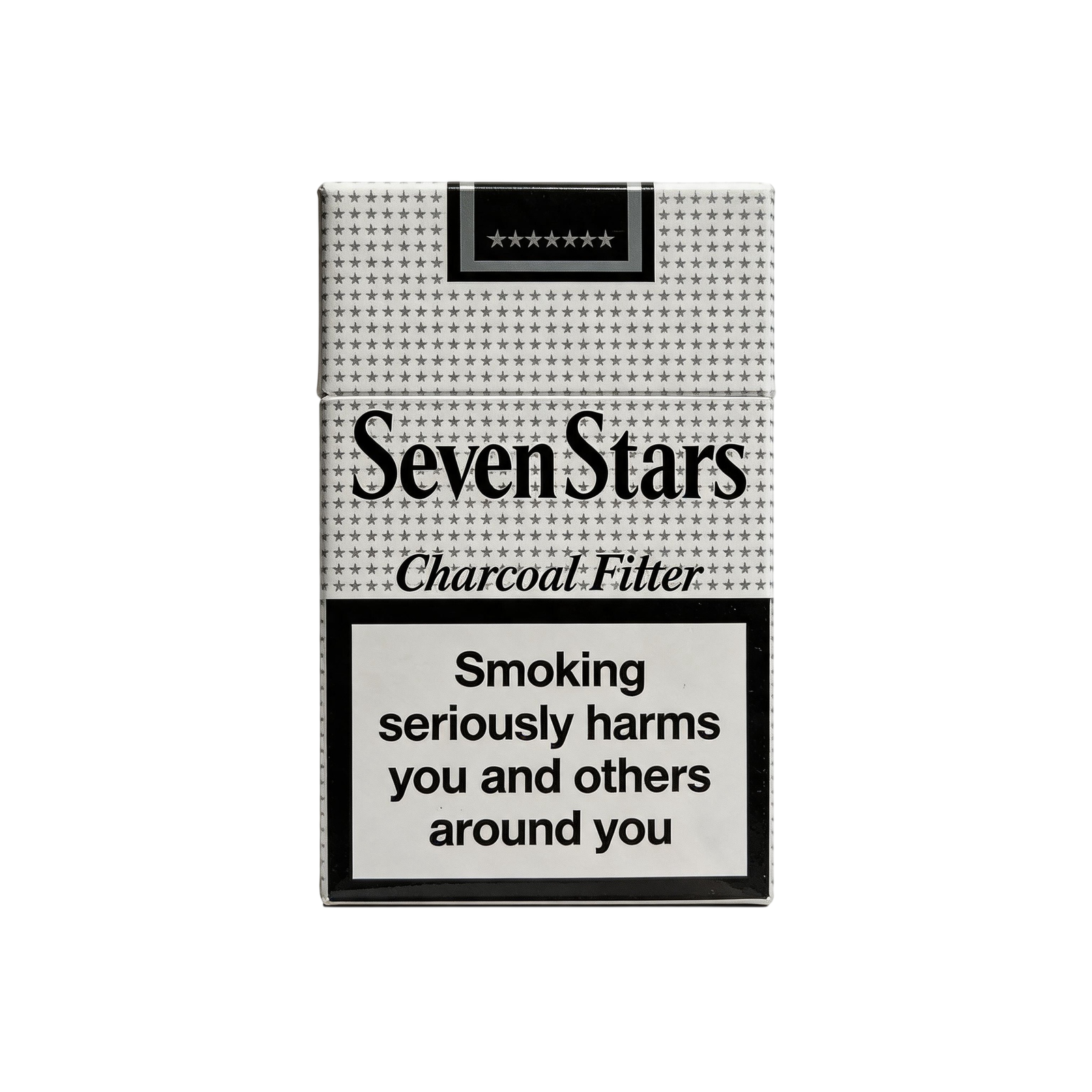
It is standard across much of the Japanese market. Both of the Japanese cartons we stock use it: Mevius Sky Blue 7mg and Seven Stars Charcoal Filter 14mg, the latter named for the feature.
Outside Japan it is less common. Some European brands use charcoal in specific lines, and a few American “smooth” variants have used carbon filters, but it is not a mainstream US feature.
How to tell if a filter has charcoal
Look at the filter through the paper, or tear one open. A charcoal filter shows a distinct dark granular band a few millimetres from the mouth end. Some packs print a diagram on the side panel.
If a pack claims charcoal but the filter shows no dark band, that is a counterfeit signal worth checking against our authenticity guide.