

Counterfeit cigarettes are a real market, and the fakes have got better. The old tells — a badly printed logo, a flimsy box — no longer reliably separate real from fake, because the people making them have access to decent printing. What still separates them is the stuff that costs money to replicate: tax stamps, foil, and consistent manufacturing.
Start with the tax stamp
On a legally sold US carton, the state tax stamp is applied by a licensed stamping agent, not by the brand. It should be intact, aligned, and legible, with the state name clearly readable. A stamp that is missing entirely, cut through the middle, or from a state that has no relationship to the seller is the single strongest signal you have.
Stamps also carry a code identifying the stamping agent. You cannot easily verify it yourself, but a stamp that looks photocopied — flat ink, no texture, slightly out of register — is a bad sign.
Check the cellophane
Real cartons are wrapped tightly, with a clean seam and a consistent overlap. The film should be clear, not cloudy, and it should be tight enough that the carton feels solid. Fakes are often wrapped loosely or with film that has a blue-grey cast.
Look at the tear strip. On a genuine carton it runs straight and pulls cleanly in one motion. On a counterfeit it often wanders or breaks.
Open a pack and look at the foil
The foil inside a pack is a real barrier, not decoration. Genuine packs have foil that is bonded cleanly to the box, with a pull tab that lifts the whole top in one piece. Fakes frequently use thinner foil that tears, or glue that has bled onto the tobacco.
Also check the printed inner frame — the paper collar inside the pack. It should be crisp and correctly aligned. On fakes it is often cropped badly or printed in a slightly wrong colour.
Look at the printing at close range
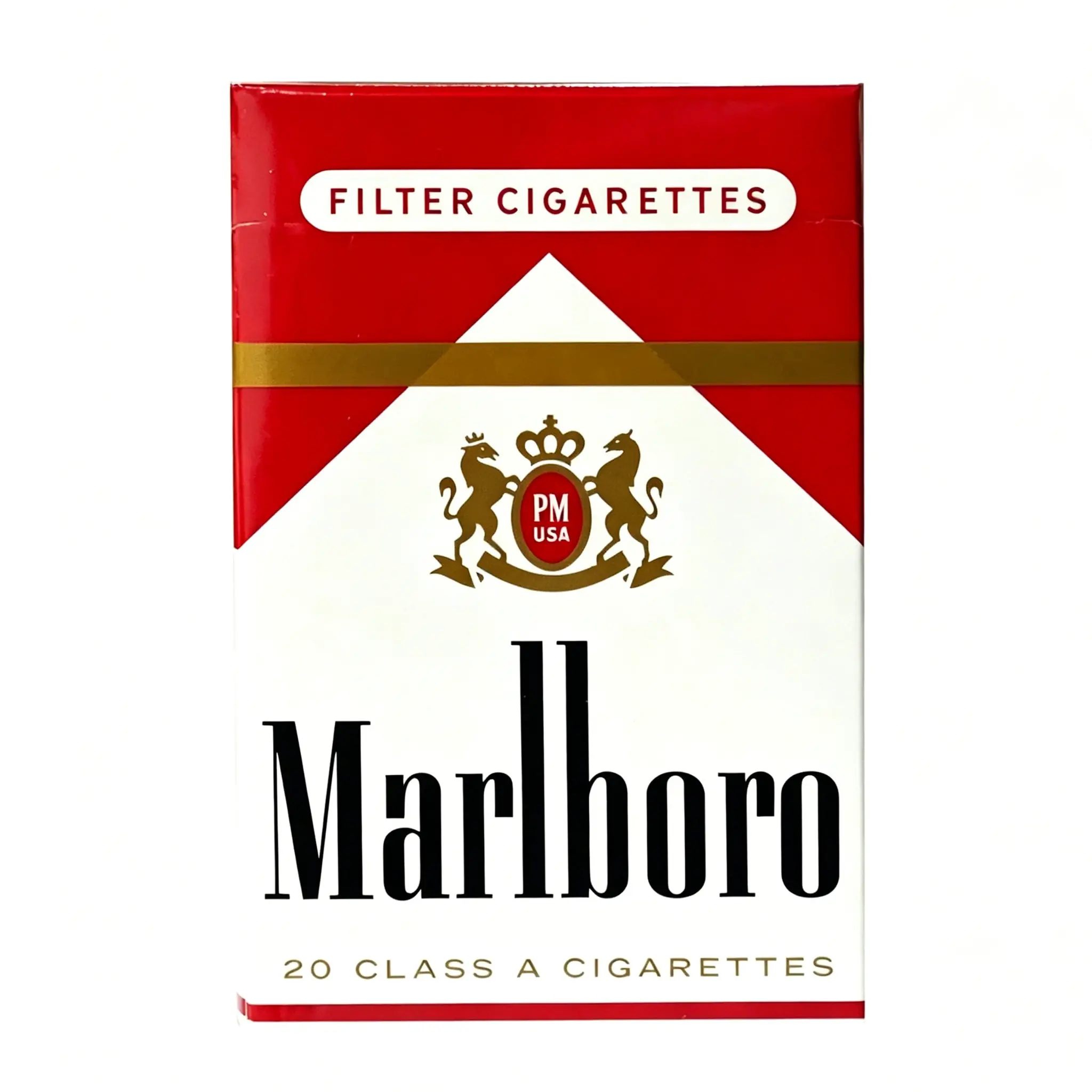
Take a photo of the front of the pack with your phone and zoom in. Genuine packaging uses fine detail that survives magnification: microtext, sharp edges on small type, consistent colour across the whole run.
Counterfeits show dot gain, soft edges, and colour drift between packs in the same carton. Compare two packs from the same carton side by side — they should be indistinguishable.
Weigh it
A genuine 20-cigarette pack is consistently weighted because the tobacco weight is controlled. If you have a kitchen scale, weigh a pack. Large variation between packs in the same carton suggests the tobacco fill is not controlled, which is common in counterfeit production.
The burn test
This is the least convenient check but one of the most informative. A genuine cigarette burns evenly down one side, holds a grey-white ash, and does not tunnel. Counterfeits often burn unevenly, produce dark ash, or go out repeatedly — usually because the tobacco is over-moistened or contains filler.
Ash colour is not a reliable indicator on its own; it depends on the blend and on the paper. But a cigarette that will not stay lit is telling you something.
Smell the pack before you open it
Genuine tobacco smells of tobacco — slightly sweet, slightly sharp, consistent. A counterfeit often smells of nothing much, or of a chemical note that reads as solvent. Menthol packs should smell of menthol at the seam even before opening, though weakly.
Where the fakes actually come from
Most counterfeit cartons enter through informal channels: someone selling out of a car, a shop with no licence, a marketplace listing with stock photos and no verifiable address. Price is the tell. If a carton is priced far below every legitimate channel, the difference is not a discount — it is a different product.
That does not mean cheap equals fake. It means the reason for the price has to be explicable. Tax-free supply, clearance and bulk purchasing all produce legitimate discounts. “It fell off a truck” does not.
What we can and cannot claim
We sell imported cartons sourced through duty-free channels, and we show real photographs of the stock we ship rather than manufacturer renders — which is the check most buyers actually want. Photographs of the specific carton, with the stamp visible, tell you more than any badge on a website.
If a carton you receive does not match the photographs, that is a returns conversation, not a debate. Our return policy covers it.